
New Features
Document Management System (DMS)
What it does
The Document Management System introduces a full-featured file management experience directly within Equinox Corporate+. Users can organise, upload, search, version, lock, and act on documents attached to any case record — all from the Files tab. This feature is available to Standard Users, Administrators, and Questel Administrators on all core case objects (Patents, Trademarks, Designs, etc.).
Folder Management
What it does
The Folder Management feature allows you to organise documents attached to your cases into folders and sub-folders directly within the Files tab. Instead of having all documents in a single flat list, you can group them by topic, stage, or any structure that fits your workflow.
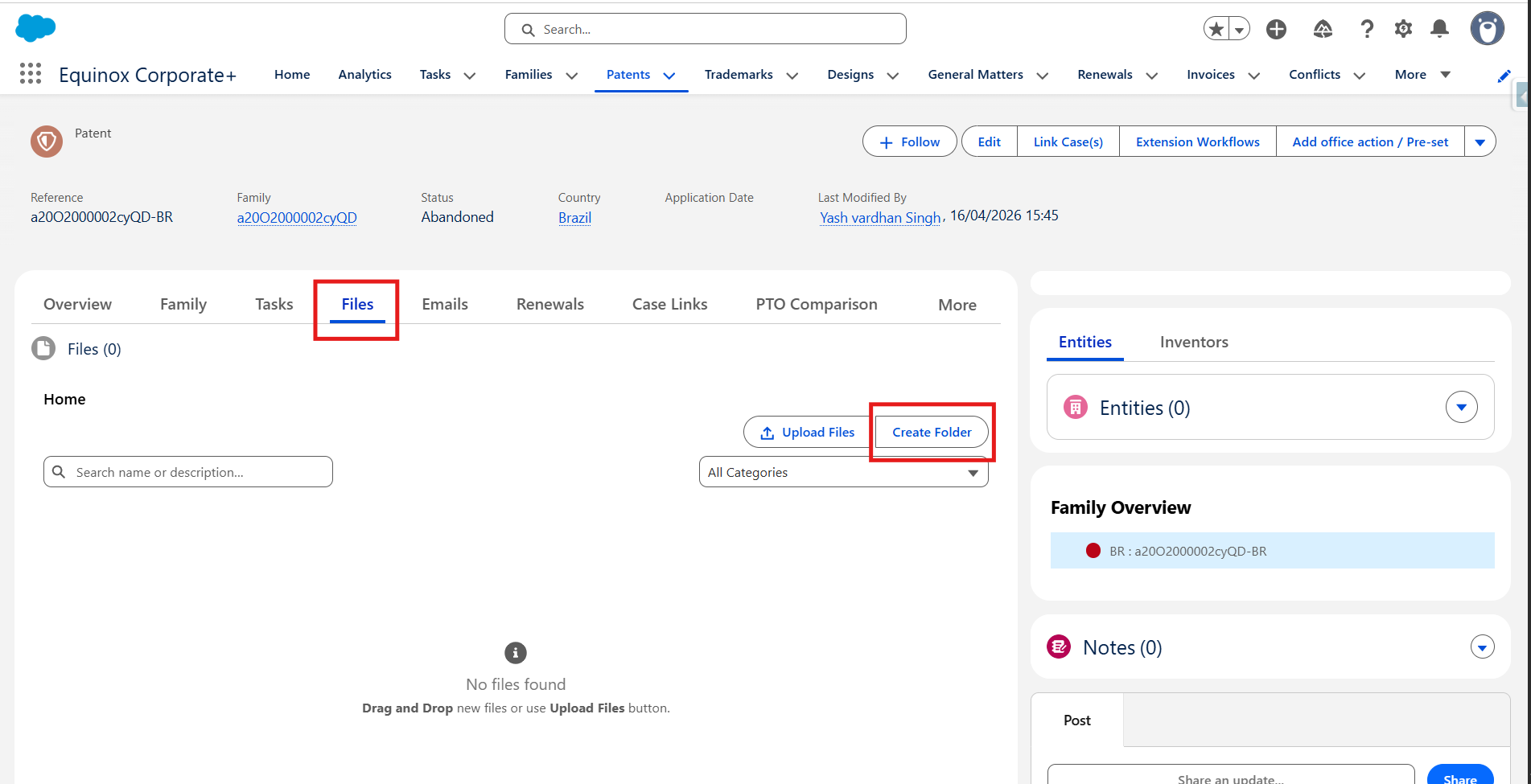
Creating a Folder
- Open a case record and navigate to the Files tab.
- At the home level, click the Create new folder button.
Note: this button is only visible at the home level — it is not available when you are already inside a folder. - In the modal that opens, enter a folder name.
- Click Create Folder.
You are automatically redirected into the newly created folder.
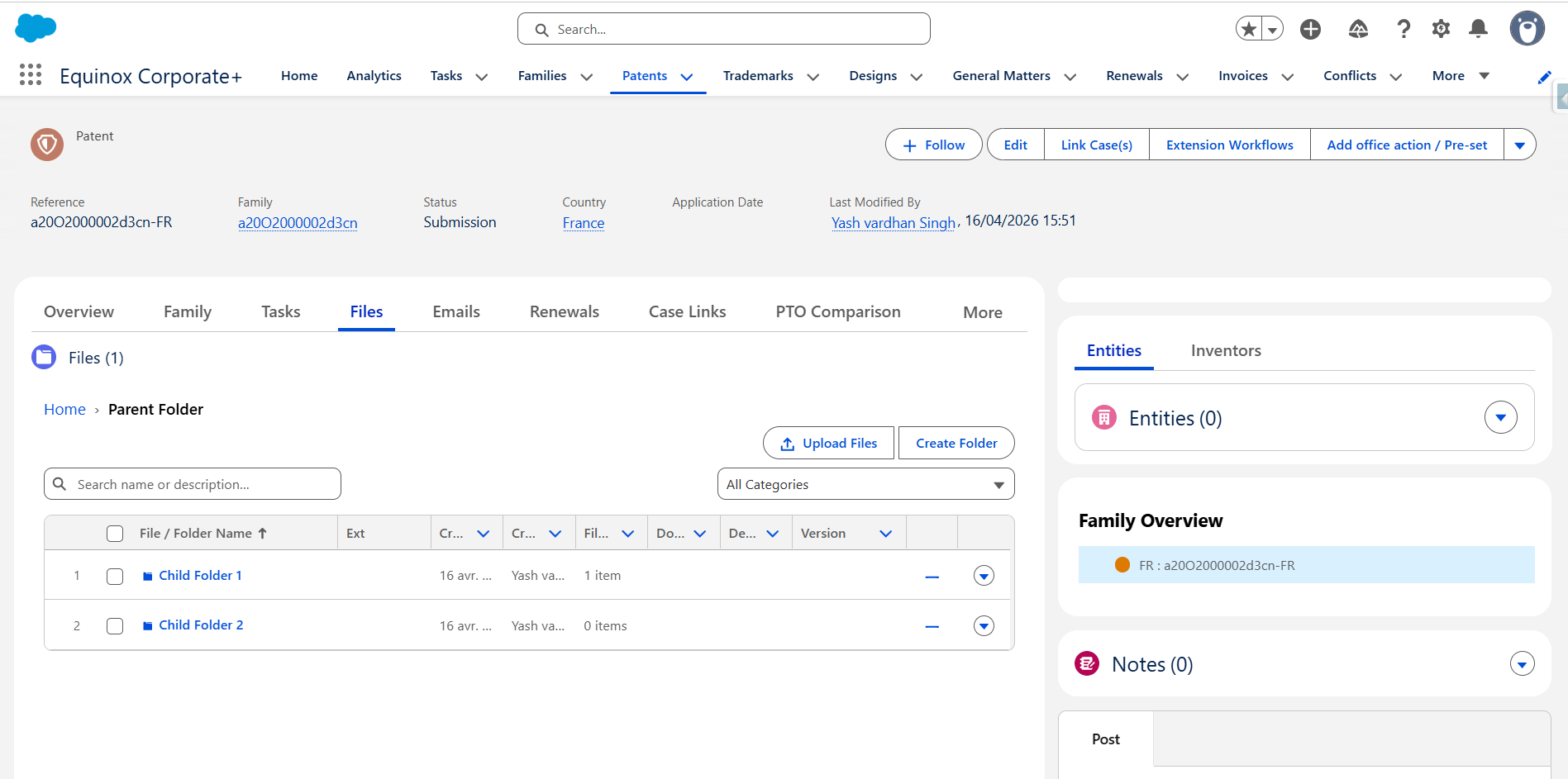
Creating Sub-Folders (Multi-Level)
You can create folders inside existing folders to build a deeper hierarchy. There is no enforced limit on the number of levels.
- Navigate into an existing folder.
- Click Create new folder to create a sub-folder at that level.
- The breadcrumb updates to show the full path as you go deeper.
Files Tab & Document Actions
Overview
The Files tab is available on every case record (Patents, Trademarks, Designs, and all other case types). It gives you a single, centralised place to view, upload, search, and act on all documents attached to that case.
Document List
When you open the Files tab, all documents attached to the case are listed. Each document displays a file type icon based on its extension (e.g., PDF icon for .pdf, Word icon for .doc/.docx, image icon for .png/.jpeg). A document count is shown at the top of the component, reflecting the total number of files attached to the case. When no documents are attached, an empty state illustration is displayed.
Searching Documents
Use the search bar at the top of the Files tab to find documents quickly. The search runs across all documents on the case and looks inside both the file name and the description of each file.
Pagination
Documents are displayed in pages of 15 per page by default. Use the pagination controls at the bottom of the list to navigate between pages.
Actions on a Single Document
Click the action icon on any document to see the available options:
- Download — Download the file to your computer.
- Share — Open the sharing window to grant access to specific users within your organisation.
- Public Link — Generate a shareable URL to distribute the document outside the platform.
- View File Details — Open the document's dedicated record page.
- Upload New Version — Open your file explorer to upload a new version of the document.
- Edit File Details — Edit the document's metadata fields.
- Delete — Permanently delete the document. A confirmation modal is required before the deletion is applied.
- Remove from Record — Detach the document from this case without deleting the file. The file continues to exist but is no longer linked to this record.
Selecting Multiple Documents
You can select several documents at once using the checkboxes. A counter showing "X items selected" updates dynamically. The following bulk actions become available:
- Download — Download all selected documents individually.
- Download as .zip — Package all selected documents into a single ZIP archive and download it in one click.
- Copy to Another Case — Available when at least 2 documents are selected. Opens the Copy to Another Case modal.
Copying Documents to Another Case
- Select the documents you want to copy (at least 2).
- Click Copy to Another Case.
- In the modal, select the object type (e.g. Patent, Trademark, Design) of the destination case.
- Use the lookup field that appears to search for and select the target case record.
- Once both fields are filled in, click Copy.
A success notification confirms the documents were copied. Note: You can only copy to objects that are accessible based on your permission set.
The File Record Page
Every document has its own dedicated record page, accessible via View File Details in the action menu. This page includes:
- Highlight Panel — A compact summary of key metadata, with the same action buttons as in the Files tab.
- Details — All core and custom metadata fields for the document.
- Related Cases — All case records currently linked to this document, with the ability to add or remove links.
- Versions — The full version history of the document. You can view and download any previous version.
- Preview — A preview of the document content directly in the page.
- History — A log of all field changes made to the document record over time.
- Tags — A widget for adding and managing topic tags on the document.
Upload & Drag-and-Drop with Metadata
What it does
You can upload documents to any case record either by dragging and dropping files directly onto the Files tab, or by using the standard upload button. Both methods support uploading up to 10 files at once and allow you to define metadata for each file during the upload — saving you from having to update each file individually afterwards.
Uploading via Drag and Drop
- Open a case record and navigate to the Files tab.
- From your computer's file explorer, drag one or more files (up to 10) over the Files tab component. The component responds visually: a blue dashed border appears around the drop zone, along with the message "Drag and drop your files here" and "Upload up to 10 files".
- Drop the files. The upload and metadata panel opens automatically.
Note: The system detects whether you are uploading from the home level or from inside a folder, and places the files in the correct location automatically.
Uploading via the Upload Button
Click the upload button in the Files tab to open your file explorer and select one or more files (up to 10). The same upload and metadata panel opens once files are selected.
The Upload & Metadata Panel
Once files are loaded, a panel opens with two sections side by side.
Left side — Upload progress
- The file name and file size.
- An upload progress bar that fills as the file uploads.
- A success icon once the upload is complete.
- An error message if a file fails to upload.
Check-Out & Check-In
What it does
The Check-Out / Check-In feature lets you lock a document so that only you can edit it. While a document is checked out, all other users can still view it in read-only mode but cannot modify it, upload new versions, or delete it. When you are done, you check the document back in to release the lock and restore access for everyone.
Checking Out a Document
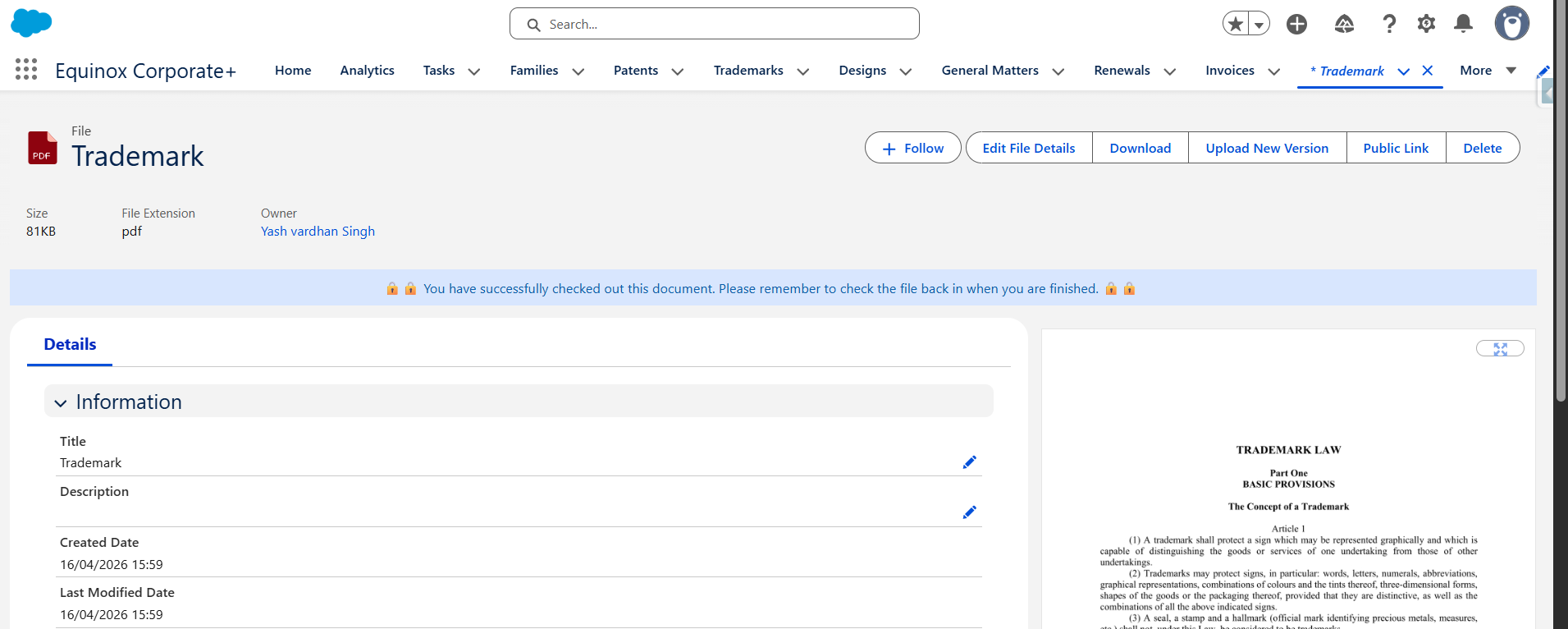
- Go to the Files tab on any case record and open the document you want to lock by clicking its name or selecting View File Details from its action menu.
- On the file record page, click the actions menu and select Check Out (located between Edit File Details and Delete).
- A confirmation pop-up explains what check-out means. Click Yes to confirm.
- The page refreshes and a green banner confirms the file is now checked out and locked to you. The Check Out button is replaced by a Check In button.
Tip: If you change your mind, click No in the confirmation pop-up to cancel without locking the document.
What You Can Do While a Document Is Checked Out (as the Checkout User)
As the user who checked out the document, you retain full access:
- Edit metadata fields on the file.
- Upload a new version (you can leave a comment explaining the reason for the change).
- Download the file.
- Delete the file.
What Other Users See When a Document Is Checked Out
Any other user who opens a checked-out document sees a red warning banner identifying the file as locked and displaying the name of the user who checked it out. On that page:
- All action buttons are hidden — no edits, no uploads, no downloads, no deletions.
- The file is in read-only mode.
In the Files tab document list, checked-out files are visually distinguished:
- The file type icon is replaced by a lock icon.
- The file name link is displayed in grey — it remains clickable so users can still open the read-only file record page.
- The only available action in the list is View File Details.
Checking a Document Back In
- Open the checked-out document's file record page.
- Click Check In in the actions menu (visible in place of the Check Out button).
- The banner disappears, the lock is released, and all other users regain their normal access to the document.
Administrator Override
A System Administrator can check in (unlock) any document, regardless of who originally checked it out. This prevents situations where a document remains permanently locked — for example, if the user who checked it out is on leave or has left the organisation. To override: navigate to the locked file's record page and use the Check In action in the actions menu.
Enhancements
Sample Data for General Matters, Invention Disclosure, Third Party Rights & Conflicts
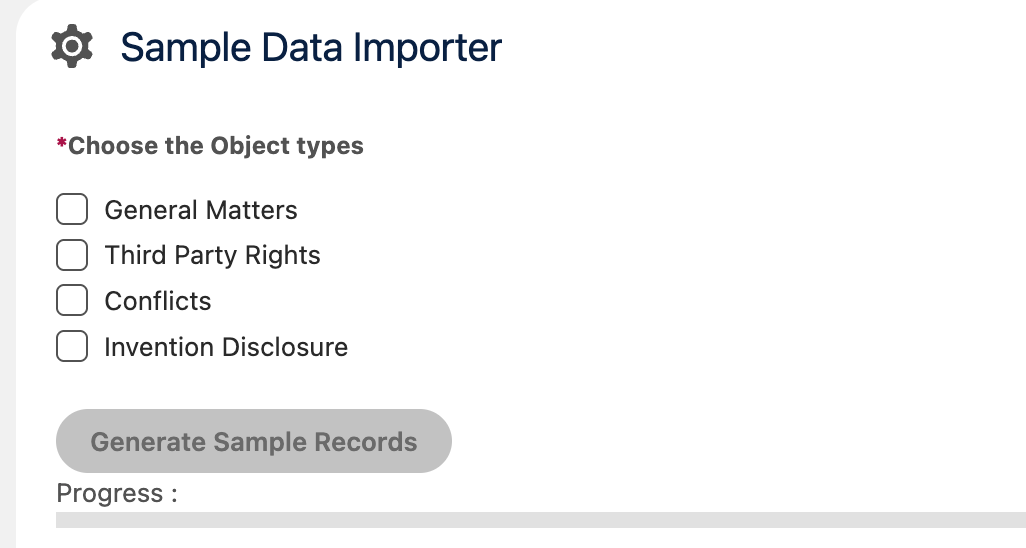
As an admin, you can access the EC+ Data Importer and select which sample data to import into your org. This now includes sample data for General Matters, Invention Disclosures, Third Party Rights, and Conflicts.
Thank you for choosing Equinox Corporate+!